Posts

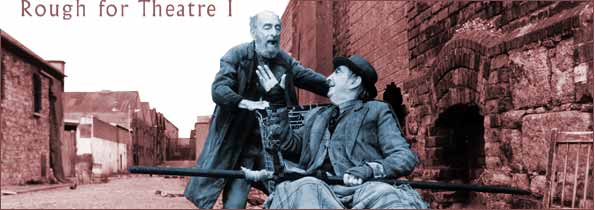
The Rough Theatre

Image
“The Rough theatre is something more experimental”. This means that we already have moved into a different type of theatre that Peter Brook has guided us into it from his book “The Empty Space”. In better words, this is a simpler form of theatre than the ones we studied before such as the deadly thatre and the holly theatre, what makes the rough theatre different than the obvious theatres is that “through the ages it has taken many forms, and there is only one factor that they all have in commonness--- a roughness”.   I would rather call it a vivid, noisy, lively, flexible, and very creative theatre.  You can touch and feel the real meaning of owning the space “The Stage” and being all comfortable with any new, quick changes in terms of plays, directors, and the actors themselves are more free with their expreissions but noticebly they are not limited as how we examined in the first two chapters.  In this type of theatres, you can easily see it’s not ...
The Immediate Theatre

Image
There is no doubt that theatre can be a very special place to appreciate and the way that artist and any creative person should look at it needs to be much more developed depending on how much they love the space (the stage) and how passionate on what they are doing, especially when they start having the sense of knowing the actual meaning of loving theatre with so much admiration, and they have to be pure true to themselves first and to others, or pretty much to the audience after all.  Theatre is different from everyday life and it can easily be not related to reality.   Personally, I think theatre is the real meaning and definition of our reality because we can notice that any play we go to watch its performance whether you are already familiar with the play before or not, but the way how its brought to you makes you believe that the story is true or it was actually taken from a true, personal story that happened to someone whose popular, it could be totally about ran...

The Holly Theatre

Image
It is my belief that Brooks talks about Holy Theatre as a way of getting practitioners, and patrons, to understand that true, Holy Theatre gets at truth. By this I do not mean, necessarily, universal truths, like fire is hot or ice is cold, but truths we hold inside. When we discover these truths, through theatre (and by this I mean doing or experiencing, not merely reading), we have the opportunity to be raised to a new level of understanding, a place, similar to our faith as we discover our spiritual truths, where we cannot really explain our discovery but we know it is real. Theatre, like religion, has had, and will continue to have, its false prophets, proclaiming that we must have or do something in order to please the gods/Gods. Yet, in discovering our truths, our holiness in understanding, we fulfill that journey. In this chapter the Director Peter Brook  defines  “The Holy Theatre” as “the Theatre of the Invisible – Made – Visible.” That is, this kind of ...

The Deadly Theatre

Image
After reading and highlighting the important key  elements  of the “Empty Space” as how it’s referd on the book that was written by the author Peter Brook, I was bale to draw out an idea of what’s the definition of an empty space and  calling  it a bare stage as how it was mentioned in the text.  Then he  splinted  the word into four ways and distinguished what are the four different kinds of theatre. These types of theatre are: Deadly Theatre, a Holy Theatre, a Rough Theatre, and the fourth one was the an Immediate Theatre. In this chapter Peter Brook was to deliver a powerful indictment of deadly  theater  for us. In better words, he was able to identify and explain with such a  detailed  relevant sequence what is deadly theatre in terms of performances that are dull and boring, providing no transcendental experience or immediate encounter with truth and beauty. In his book, Brook has focused on sev...

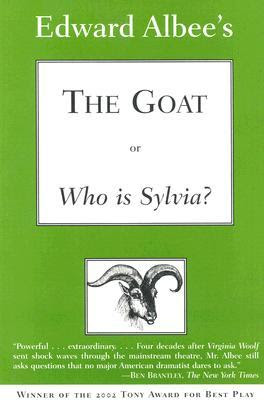
The Goat, or who is Sylvia? By Edward Albee

Image
   Who is Edward Albee? Edward Albee is the author of many plays, including the award winning (Who’s Afraid of Virginia Woolf?) and Seascape. Much can be said of his work, but the first word that comes to your mind as reader or a researcher or even if you are a theatre major is "innovative." Albee never writes the same play twice. Each new work explores different territory and his its own special incidents that takes a big spot in his work, and what I mean by that is we could tell and see how significantly any he does is absolutely different, unique and as I mentioned earlier, he never writes the same play twice. Even similarity doesn’t exist as much as how we think so!  Clearly, he’s a renewable playwright.  Although the themes can be unsettling and the format may sometimes border on avant-garde, his plays always offer new insight into the human condition. In my personal opinion, sometimes I think reading a science book might be as less complicated as how...

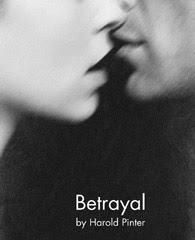
Betrayal: By Harold Pinter

Image
Betrayal is a play that was written by Harold Pinter in 1978. Critically regarded as one of the English playwright’s major dramatic works, featuring his characteristically economic dialogue, characters' hidden emotions and veiled motivations, and their self-absorbed competitive one-upmanship, face-saving, dishonesty, and (self-) deceptions. Betrayal shows people in an extraordinarily civil, although complex, relationship. The play concerns the betrayal of husbands and wives in adulterous relationships, but it also explores the power relations between the genders as well as the relationship between male friends. Betrayal was first produced by the National Theatre in London on 15 November 1978. The original cast featured Penelope Wilton as Emma, Michael Gambon as Jerry, Daniel Massey as Robert, and Artro Morris as the waiter; Wilton and Massey were married at the time. It was designed by John Bury and directed by Peter Hall.  Pinter's particular usage of revers...

A Doll's House By Henrik Ibsen

Image
Henrik Ibsen was considered the new style of realism. He was born in 1828 and died in 1906. Even though his movement in the theatre movement was going slowly and also “painfully” as how it’s says in the book but then because of his hard, significant work towards what he was looking for to accomplish in his field but of course he became the most influential modern dramatist during his time.  What most researchers and authors who have studied Ibsen’s work or at least familiar with it they all agreed on how his subjects were special in specific terms of drama, more likely subjects that’s been ignored or not touched on the stage from other playwrights, he simply added these subjects and brought them up to life after they’ve been not mentioned in specific periods of time and he made out of them a special technique of the center of his work, basically.  He was one of “the most influential European dramatist in the late nineteenth century, Ibsen inspired emerging writers i...